


From Research to Industry
FROM RESEARCH TO INDUSTRY
How My FIERF-Funded Academic Experience Launched My Career Path Into Forging
By Nafi Ul Alam Bhuiyan
Transitioning from graduate research into the forging industry was not a single leap; it was a progression shaped by hands‑on experimentation, mentorship, and early exposure to real manufacturing challenges through sponsorship from the Forging Industry Association. What began as a research project during my time at The University of Akron has now grown into a full‑time engineering career in the forging sector, and the lessons along the way have shaped not only how I work but also how I think.
Building a Strong Technical Foundation
As a graduate student in the Department of Mechanical Engineering, I worked at the University of Akron’s Advanced Manufacturing and Heat Treatment Laboratory. My mentor, Dr. Gopal Nadkarni, has decades of expertise in the steel manufacturing industry. He trained me to delve deeply into the world of steel heat treatment: microstructure evolution, residual stress, hardenability, all the details that shape how forged components are made and how they perform under demanding conditions. Steel may be one of our oldest engineering materials, but modern processing techniques continue to push it into new frontiers.
I joined a FIERF-funded research project focused on understanding how heat‑treatment variables and material chemistry influence the final performance of forged steel parts – these were common forging grades like AISI 1045, AISI 8620 and also die steel grades used in closed-die impression molds. The work was not confined to theory or modeling. I was in the lab preparing samples, running controlled heat treatments, measuring hardness and residual stresses, and analyzing microstructures. That hands‑on work grounded my understanding of metallurgical behavior in a way no textbook ever could.
How FIERF Connected My Research to Real Industry Needs
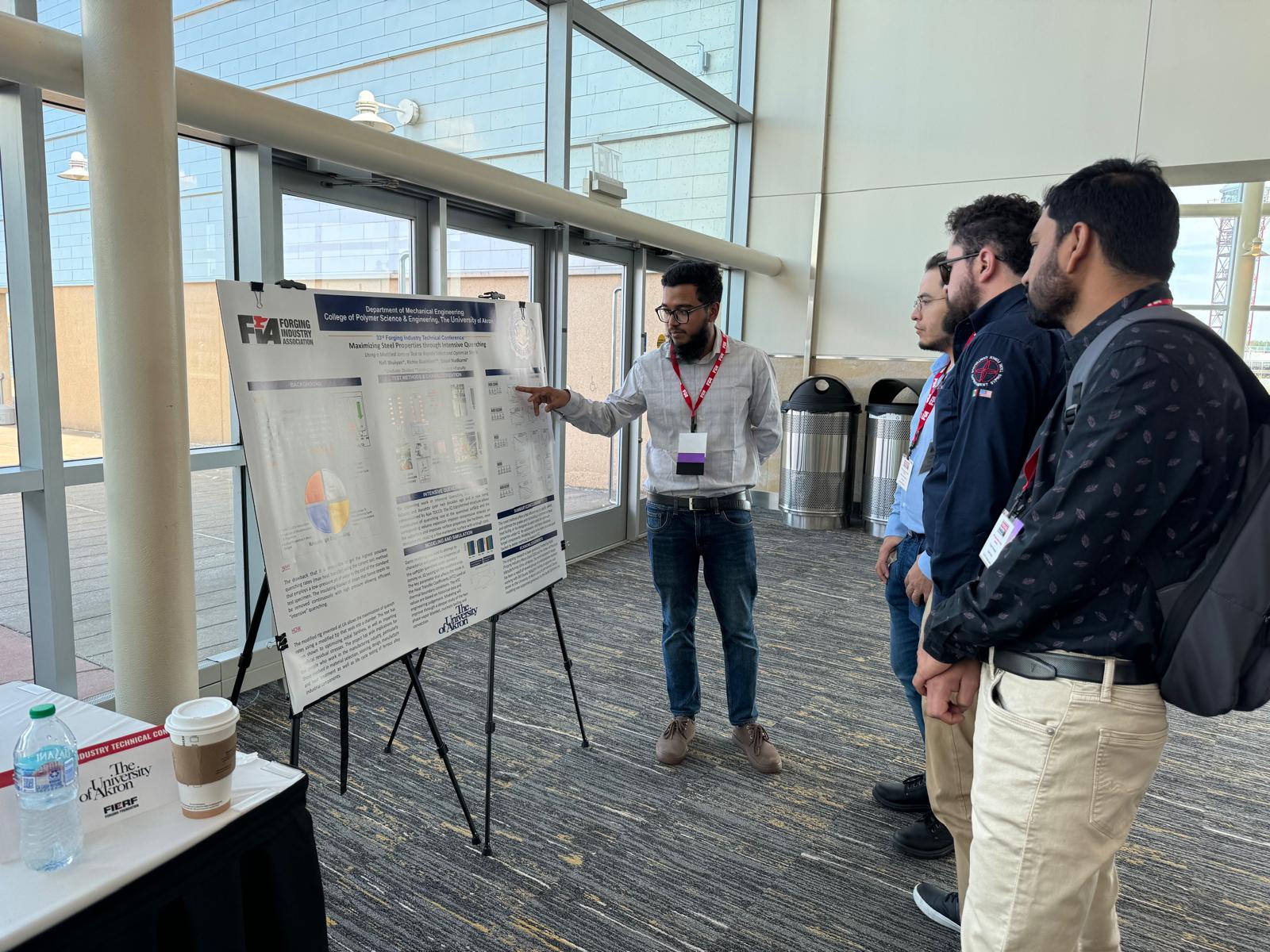
One of the most influential aspects of my academic journey was the overall support of the Forging Industry Educational and Research Foundation (FIERF). Their mission is to link students, universities, and the forging industry played a direct role in shaping my career direction. Through FIERF‑supported research, my work aligned closely with industry priorities: process optimization, material performance, and forensic analysis of failures. Even more valuable was the exposure FIERF created: conversations with industry engineers about real-world problems facing the future of the forging industry, insights into current manufacturing practices, and an understanding of the expectations that come with an engineering role in forging. Those interactions helped transform my academic work into something practical, applicable, and relevant.
During my graduate work, the Forging Industry Association (FIA) online resources and website became a critical resource and a window into the forging world. The industry overviews, technical articles, process explanations, and economic trend updates helped me build a broader understanding of where forging fits into the larger manufacturing landscape. It gave context to my research and helped me see how small changes in process parameters influence major industry‑wide concerns like quality, productivity, and sustainability.
For someone new to the field, those publicly available FIA resources were invaluable in bridging the gap between academic research and real industrial practice.
Learning Beyond the Lab
Research rarely follows a straight path; experiments fail, results surprise you, and problems get messy! Those experiences strengthened my ability to adapt, iterate, and problem‑solve, and these are the skills that are essential on any plant floor. Communicating technical insights was another major part of the process. Whether authoring reports, presenting results, or discussing findings with my mentor and peers, I learned how to translate complex ideas into clear explanations. My time as a Teaching Assistant in the Materials Testing Laboratory reinforced these communication and analytical skills even further.
The deeper I got into my research, the more I saw how directly it connected to real‑world manufacturing challenges. Cooling rates and phase transformations influence quench cracking and distortion. Microstructure, particularly hardened surfaces, influences fatigue life. Residual stress determines dimensional stability. These connections strengthened my appreciation for applied research and made me eager to experience forging from the industrial side.
As part of my graduate research, we developed a high-pressure rapid water quenching technique that enables uniform cooling by eliminating the vapor barrier typically formed during quenching. This advancement resulted in improved surface hardness, increased hardenability, and the development of compressive residual stresses, all while reducing distortion. The benefits of this method were validated across different grades of tool and die steels and resulted in a summary report to the Forging Industry members.
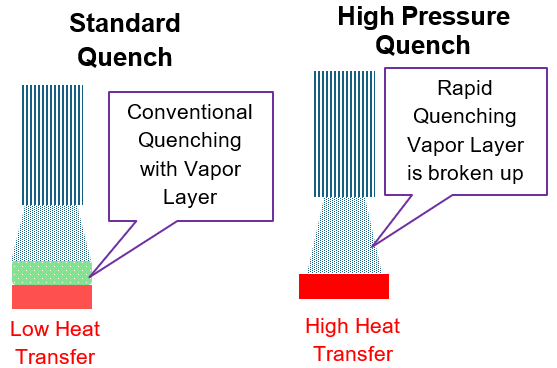
Schematic of Standard Quench vs Rapid Quench
Joining Aichi Forge USA
An opportunity to use my skills arrived when Aichi Forge USA, a leader in advanced forging for automotive, aerospace, and manufacturing applications offered me a position. Suddenly, everything I had studied - heat treatment optimization, steel behavior, phase transformations - was part of my daily work. Working in a production environment added new dimensions: efficiency, scalability, throughput, and quality assurance. And seeing the life cycle of a forged product from raw material to customer application deepened my appreciation for the precision and craft behind every component.
Growing Through Industrial Challenges and the Role of Mentorship
Industry moves fast. Production deadlines, cross‑functional teamwork, and process constraints present a different set of challenges than academia. But the same skills I developed through research i.e., critical thinking, data‑driven decision‑making, attention to detail proved highly transferable.
Collaboration is at the heart of industrial engineering. At Aichi Forge USA, I work with teams in tooling, design, maintenance, production, and quality. Those interactions have strengthened my communication skills and broadened my understanding of how forging facilities operate as a cohesive system.
At every step, academic and industrial mentorship played a guiding role. My mentor during graduate school encouraged me to ask “why” at each stage of a process, pushing me to develop depth in both theory and application. He encouraged me to network and connect with industry professionals. Guidance from industry professionals shaped my understanding of the forging world and helped me navigate my path into the field.
The Power of FIERF Student Access and Industry‑Supported Projects
FIERF’s commitment to supporting the next generation of engineers played a significant part in my journey. Their policy of granting university students free access to the Annual Forging Technical Conference allowed me to attend sessions, meet professionals, and understand industry challenges firsthand. These are opportunities I could not have accessed otherwise. Beyond events, FIERF funding of university research projects and the involvement of industrial champions bring unmatched exposure to students. These partnerships are vital not only for education, but they are also essential building blocks for the resurgence of American manufacturing and the strengthening of national self‑sufficiency in advanced manufacturing technologies.
My path from academic research to the forging industry has reinforced one key lesson: the strongest engineering work happens at the intersection of theory and application. Supported by FIERF, enriched by FIA resources, and guided by mentors, I found a career that continues to challenge and inspire me. I look forward to contributing to the future of forging and manufacturing through innovative ideas and by encouraging other students to explore a field that is shaping the backbone of modern industry in North America.